
TOKYO Enmusubi Review: The Good and the Hard Parts After About Two Months
目次
"An incredible bargain." That was my first thought when I came across TOKYO縁結び (TOKYO Enmusubi) in an online news story or on social media.
The private dating apps I was looking at back then cost around 3,000 to 5,000 yen a month (around 2024). This one, by contrast, charges a single 11,000-yen registration fee for two years. I signed up with high hopes. According to my member page, I've been introduced to 13 people so far, and not one of those introductions turned into an omiai (a first meeting arranged through the service).
Even so, if a friend asked whether they should sign up, I would recommend it. The reasons are the price and the screening. In this article, I'll cover both why I'd recommend it and the parts that didn't work for me, which I'd mention in the same breath.
Some background first
#- When: I applied in fall 2024 and started activity in mid-November. My login records stop around the end of the year, so I used it for about two months.
- What I paid: the 11,000-yen registration fee, plus less than 1,000 yen to get my certificate of single status.
- Who I was: a man in his late 20s, in my first year of marriage hunting. If I had to sum up why I wanted to get married, it would be: "Honestly, I was tired of being alone." I was also using the dating app Pairs at the same time.
- Numbers: 13 introductions (cumulative total on my member page) → I replied "I'd like to meet" to 5 → 0 omiai → 0 relationships.
- Result: I didn't meet anyone through TOKYO縁結び.
What TOKYO縁結び is
#TOKYO縁結び is a matchmaking service for people who want to get married, launched by the Tokyo Metropolitan Government in September 2024 (Tokyo press release, Japanese). Based on a values assessment, an AI introduces potential partners.
According to the official page, the main conditions as of October 2026 are as follows (TOKYO縁結び official site, Japanese).
- Registration fee: 11,000 yen (tax included), valid for two years from the first day of the month after you start activity
- Eligibility: single people aged 18 or over who want to marry and who live, work, or study in Tokyo
- You submit photo ID, a certificate of single status, proof of income and other documents, and complete an online intake interview
- The AI introduces up to 4 people a month, and you can send up to 6 requests a month through the search function (FAQ, Japanese)
When an introduction arrives, you reply by a deadline with whether you'd like to meet. If both sides say yes, an omiai is arranged.
It took about a month just to register
#The first hurdle was booking the intake interview. There were no open slots, online or at the in-person venue.
"Wait, nothing open this month? Nothing until the end of next month... seriously?"
In the end, the earliest I could get was about a month out. But the disappointment didn't last. I thought, "It must be popular," and my hopes actually went up. Back then, I was thinking:
"With a service like this, the more people registered, the better."
Compared with the month of waiting, the interview itself was over quickly. I barely remember it.
Getting my certificate of single status from my hometown
#The paperwork took more effort than the interview. A certificate of single status is issued by the municipality where your family register is kept, so I had to request mine by mail from my hometown's office.
Here's what I did:
- Downloaded the application form from the web
- Prepared a return envelope
- Prepared a teigaku kogawase (a fixed-amount postal money order)
That third item was something I had never even heard of until then. Of all the words I picked up while preparing for marriage hunting, it sounded the least like marriage hunting.
It was a hassle. The hardest part was getting the application and everything around it ready. In total, it cost less than 1,000 yen.
The fee varies by municipality. For example, Chuo City and Koto City charge 300 yen per copy, and Sapporo charges 400 yen (as of October 2026, Japanese pages). Postal money orders also come with a charge of 200 yen each on top of their face value (Japan Post Bank fee page, Japanese, as of October 2026).
After the introductions started
#I started activity in mid-November, and when my first introduction arrived, I was genuinely happy.
"Here it comes!"
I gave a quiet fist pump in my head.
When I opened an introduction, the first thing I looked at was the photo. I replied "I'd like to meet" to 5 people. All 5 replies on the other side were a no.
The remaining 8 were automatically declined because I didn't reply before the deadline (the other person had declined as well).
I also used the "search service," where you can send requests yourself. I don't remember how many I sent, and I couldn't confirm it from my records, but none of those led to an omiai either.
In the evenings, I'd open both Pairs and TOKYO縁結び. But since nothing was matching (both sides saying "I'd like to meet") on TOKYO縁結び, I gradually stopped opening it.
What was good: the price and the screening
#What I hoped for before I started is still what I'd call the good part, even now that I've stopped using it.
The first is the price. The 11,000-yen fee covers two years, and even including the certificate, I paid about 12,000 yen in total.
The second is the screening. Because you have to submit a certificate of single status and proof of income, it felt like a place where only people who were serious would be.
Back then, I believed that private apps also had scammers and people with business motives mixed in. Here, the local government had already done that filtering for me. I appreciated that.
What was hard: if nothing matches, there's nothing you can do
#The hardest part was the introductions themselves.
To me, the AI's matching didn't feel very accurate. By my own sense of it, about half of the introductions were people outside the preferences I had set, such as age or marital history. I have no records to back this up, so it's simply how it felt to me.
The other issue was how few moves I could make myself. The AI introduces up to 4 people a month, and you can send only up to 6 requests a month. I'm not someone who stands out in the dating world, so not being able to reach out to more people was a problem for me.
On TOKYO縁結び, when nothing matched, there was nothing I could do. I'll get to how it compared with Pairs, which I was using at the same time, in a later section.
Looking back, the AI's accuracy may have been because the service had just started and didn't have much data yet. I was using it only about three months after launch, so it may have improved since.
What it cost: about 12,000 yen
#| Item | Amount | When |
|---|---|---|
| Registration fee (valid for two years) | 11,000 yen | October 2024 |
| Getting my certificate of single status (fee, postal money order, etc.) | Less than 1,000 yen | Fall 2024 |
| Total | About 12,000 yen |
That's all I paid. There was no monthly fee. Please check the official page for current prices. To renew your membership, you need to pay the 11,000-yen registration fee again and resubmit your documents (as of October 2026).
Who it suits, and who it doesn't
#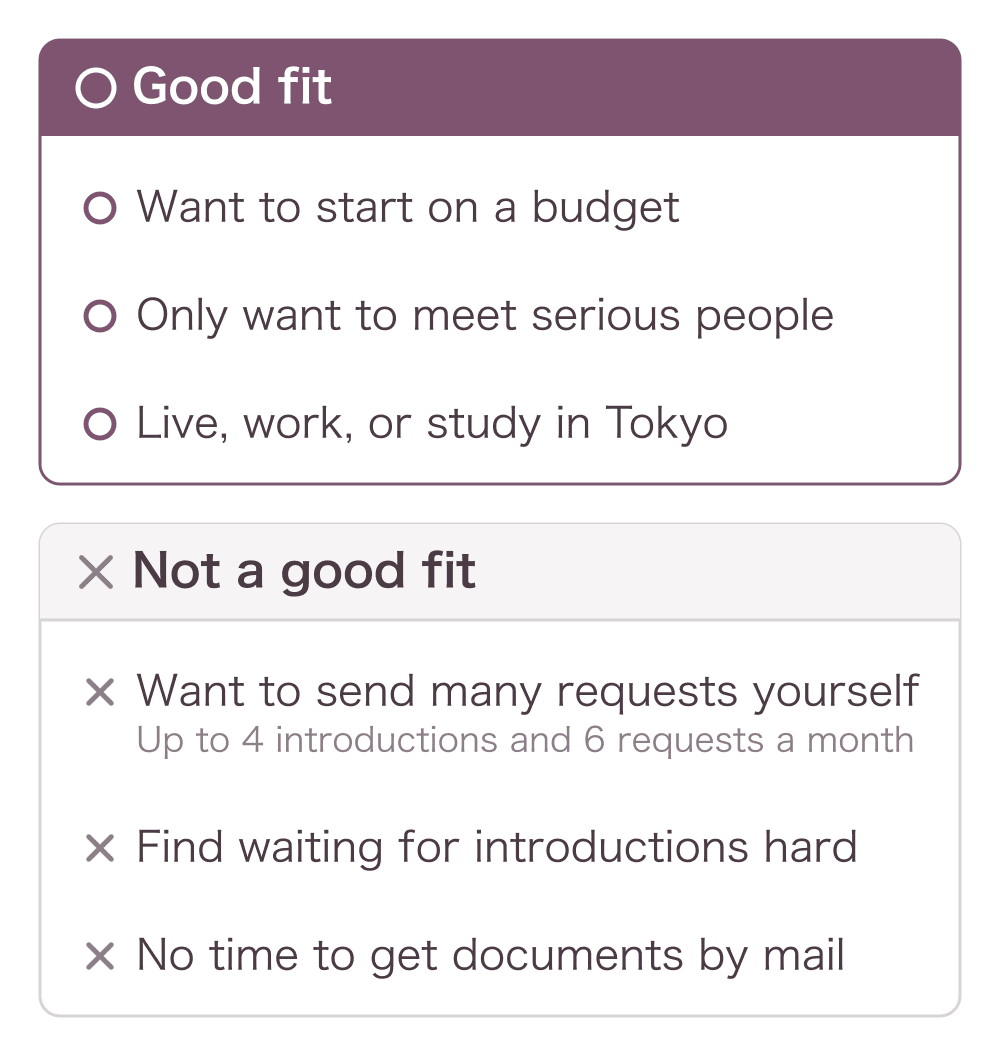
Based on my experience, it suits people who:
- Want to try one form of marriage hunting while keeping costs down
- Only want to meet people who are serious about marriage
- Live, work, or study in Tokyo (a basic requirement)
It doesn't suit people who:
- Want to send lots of requests themselves and play the numbers. Introductions are capped at 4 a month, and your own requests at 6 a month
- Find waiting for introductions hard. While nothing matches, there's very little you can do
- Have a family register far away and can't spare the time to get documents by mail
Using it alongside Pairs
#At the time, I split my marriage-hunting time roughly half and half between TOKYO縁結び and Pairs.
The biggest difference was whether I could take action myself. On Pairs, there were messages and phone calls. On TOKYO縁結び, you can only wait until an introduction works out.
I also used the marriage support service of my hometown's local government, and there I did get as far as a relationship. Both were local-government marriage support services, but for me the results were different. I plan to write about the hometown one in a separate article.
If I started over
#There's very little I'd change. I put everything I had into my profile and photos at the time.
If I had to name one thing, I wish I'd had someone else review my profile and photos before posting them.
The takeaway: have your photo and profile ready on the day you register
#The "incredible bargain" and the screening were just what I'd hoped for. But because it's a system where you wait for introductions, if nothing matches, there's nothing you can do. If it doesn't suit you, letting it go quiet the way I did and putting that time into other kinds of marriage hunting is one way to call it.
If you still want to sign up, I'd recommend having your best photo and your best profile ready by the day you register. When I used it, the search results were sorted by registration date by default. I feel that the period right after you register is when the most people see you.
Have that photo and profile looked over by someone once before you post them. If I did it again, that one step is the only thing I'd add.