
Municipal Matchmaking from Tokyo: I Met 4 People and Dated 2
目次
I'm Kon-chan. I tried all four kinds of matchmaking services and got married. Fair warning: there are more stumbles here than success stories.
"Yes! A match! So happy!"
That was the voice in my head when a meeting was confirmed through my home prefecture's matchmaking program. I was living in Tokyo at the time, and when a meeting was set, I took the bullet train back home.
Here is the result first. I met 4 people, and went on to date 2 of them. Neither led to marriage.
The registration fee was ¥10,000. The bullet train fares to go and meet people, for meetings and dates, came to about ¥360,000 in total.
Let me say this up front: that ¥360,000 came from my own situation, traveling in from outside the prefecture while living in Tokyo. The only thing I paid the program itself was the ¥10,000 registration fee. If you live in the prefecture, you should hardly need any bullet train fares.
The basics of this article
#- What I used: a matchmaking program run by my home prefecture (a system where you find partners through AI introductions and search)
- When: I registered in autumn 2024. I was sending requests and going to meetings until December that year. I stopped around the first half of 2025, and my membership ended in autumn 2026 when the registration period expired
- What I paid: ¥10,000 registration fee, about ¥360,000 in bullet train fares (about 12 round trips), and under ¥1,000 for a certificate of single status. Only the registration fee went to the program; the train fares came from my own situation of commuting from Tokyo
- Me at the time: a man in his late 20s living in Tokyo, in my first year of looking for a partner. During the same period I also used the dating app Pairs and Tokyo's own program, TOKYO縁結び (Tokyo Enmusubi)
- Numbers: 24 requests and introductions → 5 omiai confirmed (1 cancelled) → met 4 people → dated 2. I met about 17% of the people I was matched or requested with
- Result: both relationships ended
How municipal matchmaking works, and how I registered
#How the program I used works
#According to the terms of use and the members' Q&A as of October 2026, the main points are below. I have not checked whether they were the same in 2024, when I used it.
- The registration fee is ¥10,000 (tax included), valid for 2 years from registration. The terms of use mention no monthly fee, introduction fee, or success fee
- It is open to single people aged 20 or over who want to marry and who live or work in the prefecture. People living outside the prefecture are also eligible if they plan to move there in the near future
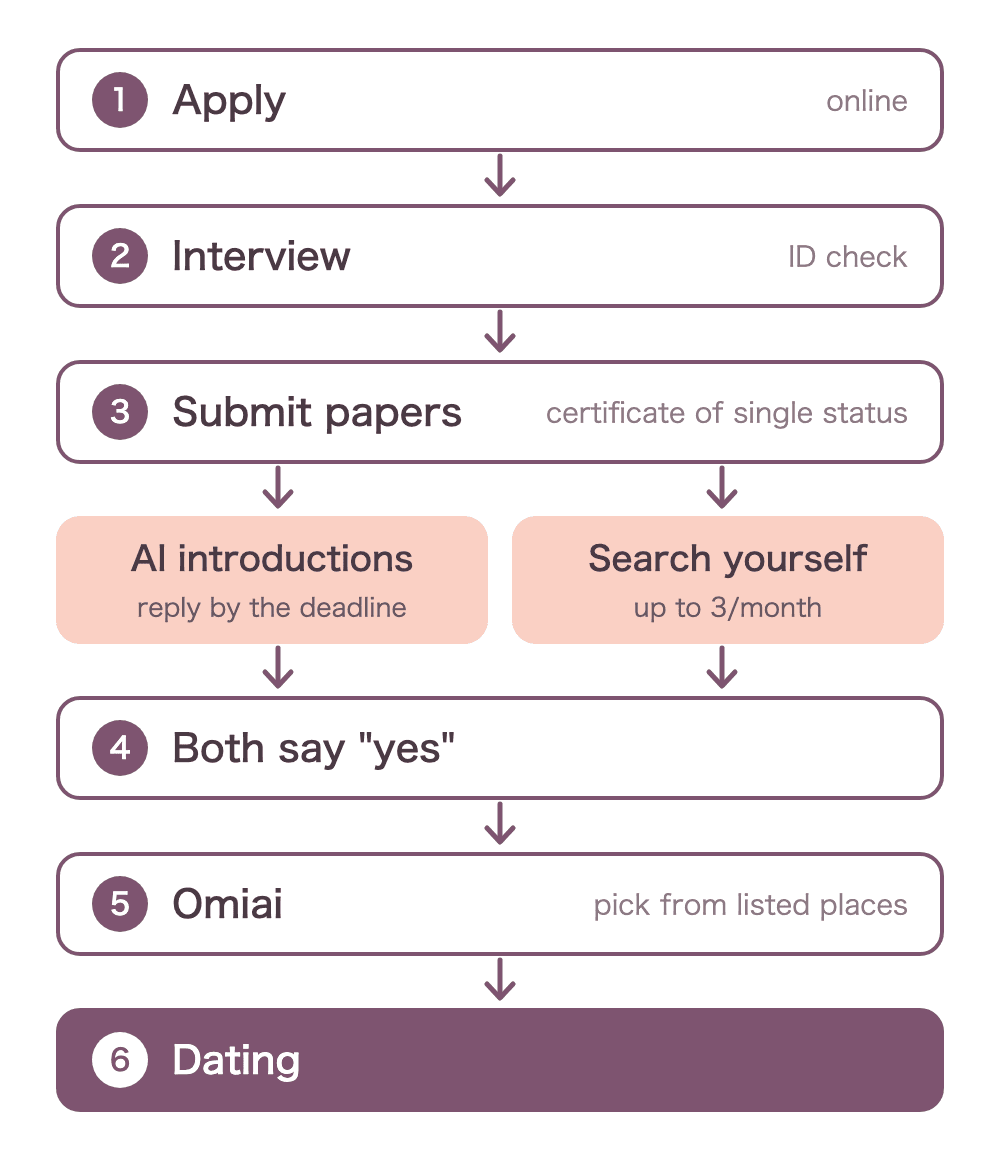
- AI introduces potential partners. If you don't reply by the deadline, the introduction is automatically declined
- You can send requests to up to 3 people a month through search. Unused requests do not carry over to the next month
- When both people say they want to meet, an omiai (a formal first meeting arranged by the program) is set. You arrange the date on your member page and choose the place from a list of options
Since I am keeping the region private, I have not linked to the official page. You can check whether the prefecture you live in, or your home prefecture, has a similar program on its website. Fees and conditions differ by prefecture.
Registration was smooth, but no introductions for 3 weeks
#I found out about this program through the news. My job at the time was fully remote, so moving back home would not have been a problem. I was fine with living either in Tokyo or back home.
Registration went smoothly at every step. After applying, I had an online interview and was able to start within about a week. I ordered a certificate of single status from my hometown just for this registration.
With TOKYO縁結び, which I applied to a little later that autumn, it took about a month just to get an interview slot.
However, for about 3 weeks after I started, not a single AI introduction arrived.
"What? Zero again this week? Something's definitely wrong..."
I called the office. According to the email I received the same day, the target area for my introductions had been set to "Kanto." They said it was an oversight on their side, and they quickly changed it to my home area.
Meetings and dating, commuting from Tokyo
#Meeting at the station, then an hour at a café
#Once a meeting was confirmed, I took the bullet train home.
We would meet at the station and talk for about an hour at a café. If I wanted to see the person again, I said one thing at the end: "I'd be happy if we could meet again." Then we parted. Afterwards, I either went to my parents' home or went back to Tokyo the same day.
The place is chosen from a prepared list, so there is no need to discuss with the other person where to meet. That was one of the good parts.
On the train home, I usually reflected on how the day went. Traveling that far raised my hopes, so the days when the conversation didn't click with someone whose profile I had looked forward to were sad.
I stopped my 10-minute self-introduction and started with small talk
#What I reflected on most was always my own questions and topics.
At first, as soon as we sat down, I would open with "Let me start by introducing myself." I would then talk about myself for about 10 minutes. As I talked, I could feel the other person getting bored.
Looking back, it was an embarrassingly stiff greeting. From the other person's side, it probably felt less like an omiai and more like an interview where they had to listen to a self-pitch nobody asked for.
So I changed my opening line.
- Before: "Let me start by introducing myself."
- After: "Do you come to this area often?"
I dropped the formal greeting and got to know each other through natural conversation instead.
Being able to talk with someone I had just met for an hour and actually enjoy it to some degree: I think that was a really good thing.
Different timelines for marriage
#I dated 2 people, both toward the end of the year.
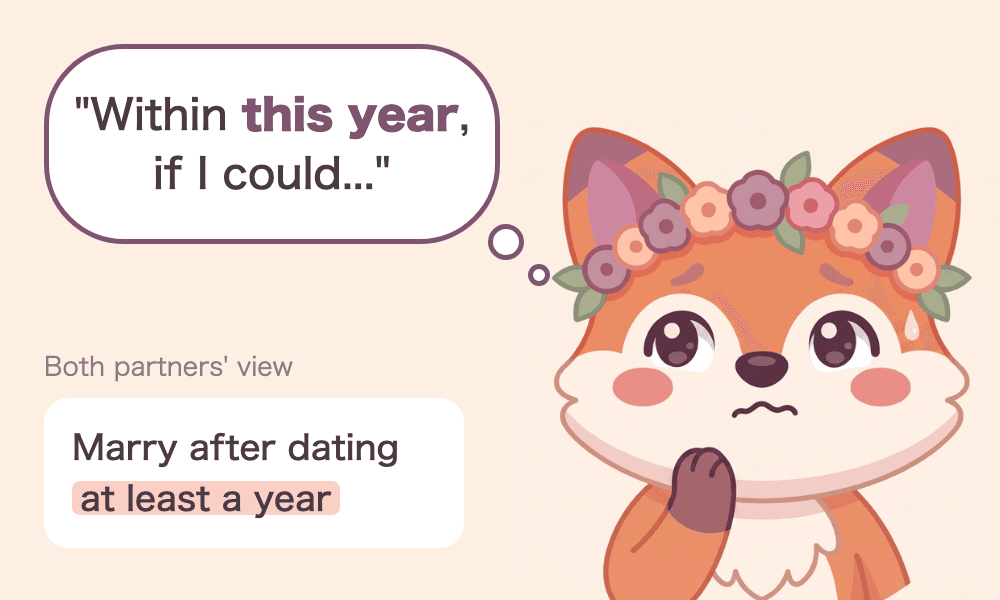
With both of them, I felt a gap in how we thought about the timing of marriage. Both of my partners wanted to date for at least a year before marrying. I wanted to marry within the year if possible.
I couldn't tell them how I honestly felt. I kept dating with that unresolved feeling.
In the end, both relationships ended.
Around the first half of 2025, I also stopped using this program. In my case, I didn't meet anyone whose timeline for marriage matched mine. I thought a marriage agency would be a place where everyone shared that understanding, so I decided to join one.
What was good, and what was hard
#What was good
#First, the cost and the screening. The registration fee is ¥10,000 for 2 years, and you must submit a certificate of single status. I liked that the price was reasonable and that this screening existed.
Arranging meetings was also easy. Dates are set on the member page, and you just pick a place from the list. I never had to decide where to meet through back-and-forth with the other person.
And then, the people I met. We were from the same area, so our backgrounds didn't feel that different, and we often got along in conversation. I felt that people I met in my daily life in Tokyo had completely different school years and careers.
What was hard
#The hardest part was traveling from Tokyo. A round trip on the bullet train cost about ¥30,000. I made about 12 round trips just for matchmaking, for meetings and dates.
The other was the number of requests. Through search, you can send requests to only 3 people a month.
For three months that autumn, I used all 3 every month. For me, 3 a month felt like too few.
Of the 24 requests and introductions, 19 did not lead to an omiai. 8 were declined by the other person, 8 were automatically declined because I didn't reply by the deadline, and I declined 3 myself.
What it cost: about ¥370,000
#| Item | Amount | When |
|---|---|---|
| Registration fee (valid 2 years) *paid to the program | ¥10,000 | Autumn 2024 |
| Certificate of single status | under ¥1,000 | Autumn 2024 |
| Bullet train (about 12 round trips × about ¥30,000) *my situation, commuting from Tokyo | about ¥360,000 | Autumn 2024 to first half of 2025 |
| Total | about ¥370,000 |
The only amount I paid to the program itself was the ¥10,000 registration fee. The terms of use as of October 2026 also mention no monthly fee, introduction fee, or success fee.
More than 90% of the ¥370,000 was bullet train fares, which came from staying in Tokyo and traveling home for every meeting and date.
If you live in the prefecture, all you pay is the ¥10,000 registration fee and the certificate of single status (under ¥1,000 in my case), for about ¥11,000 in total. Local travel to the meeting place is extra.
This is not what everyone pays. Please treat it as one example for deciding whether to use a program like this from outside the prefecture.
Who it suits, and who it doesn't
#Compared with TOKYO縁結び
#During the same period, I also used Tokyo's program, which I wrote about in my TOKYO縁結び experience review. Both are local government programs with AI introductions and a required certificate of single status.
The results were opposite. With TOKYO縁結び, I received 13 introductions and had 0 omiai. With my home prefecture's program, I met 4 people and dated 2.
When I registered for TOKYO縁結び, I thought, "The more members, the better." I felt that Tokyo had far more members. Yet the place where I actually met people was my hometown, with fewer members.
I don't know the exact reason. Looking back now, I feel that with fewer people, it may have been easier back home to engage with each person one by one.
Best for people who want to move back home
#From my experience, I think it fits people who:
- want to move back to their hometown
- want to marry someone from their hometown
- want to keep the registration fee low and look for a partner in a place that screens with a certificate of single status
On the other hand, it may not fit people who:
- are fine living either in Tokyo or back home. Commuting from outside the prefecture was too heavy a burden in money and time for me
- want to send lots of requests themselves. Search requests are limited to 3 a month
In summary: start with the place, not yourself
#"Yes! A match!" I'd celebrate, then board the bullet train. Those trips came to about 12 round trips and about ¥360,000. That is the figure for someone commuting from outside the prefecture like me.
If I could go back to autumn 2024 as I am now, I would hesitate, but as someone living in Tokyo, I don't think I would use this program. If you have decided to move back home, it's a different story.
If you register planning to move back home, try making your first words at an omiai about the place where you met, not "Let me start by introducing myself." For me, that made the first hour with someone new easier.
Taking a break, quitting, and starting over are all part of it. Here's to matchmaking without overdoing it.
I also post about dating and matchmaking on X (@konchan_yurukon). If you'd like to keep up, I'd be glad to have you follow along.